Showing posts with label Reading. Show all posts

Friday, 2 August 2013

"My Place" for Teaching Year 9 Humanities

It is time for me to start sharing some wonderful activities I have run during the past few weeks. In the last three weeks, I have taught Year 9 Humanities, Year 8 Maths, Year 8 English and Year 7 English. It has been a learning curve but also a great way for me to use some old activities and strategies and refine them for a different age group. 

Last week, I ran an activity with my Year 9 Humanities class based upon the book "My Place" by Nadia Wheatley and Donna Rawlins. I have used this book before at the primary level when teaching history and was so glad that I was able to use it again. This book, if you haven't read it, is absolutely wonderful and can be used for practically teaching anything! It focuses on a house and tracks the owners of the house on a ten year basis. It starts in 1988 and each new page is ten years prior and is written by a person living in that house. It goes all the way back to 1788 (the year that Australia was settled). 


The Year 9 Humanities class I was teaching is working on a unit called "Sunbury vs. City" where students look at the community they live in and how they can make a difference. This is a cross between history, geography and civics and citizenship. For this activity, we looked at the skills of creating a timeline as well as investigating family history and what changes and remains constant over time. Students worked in pairs and were given one time period to investigate from the book. They needed to identify who lived in the house during that time period, what significant events were occuring to both the family living there and in the time period, and what locations were significant for the person living in the house (each time period has a map of the local community). Students then shared their findings with the class and we created a massive timeline across the room with the information. We were then able to identify when families moved out of the house, what stayed the same with the house, what stayed the same and changed with the neighbourhood. 

It was such an enriching and amazing activity as you could really see students making so many connections; between the time periods and the families, with the time period and historical events (e.g. WWI, Vietnam, Great Depression, immigration). I highly recommend that all teachers get themselves a copy of this book. It is full of colour and imagination and can be used to for all sorts of activities and to teach and lead some wonderful discussions. It is exciting to find such a fantastic book that can be used across the academic levels!

Friday, 24 May 2013

Comparing and Contrasting Text

Like I mentioned previously, I really wanted to start finding great texts to use for teaching different skills in reading. In my post about Cause and Effect, I used some texts that worked really well. 
 
For teaching comparing and contrasting, I absolutely love the book "Mirror" by Jeannie Baker. It is a lovely book of comparisons between an Australian family and one in Morocco. The book is designed so you can see the pictures and story simultaneously. It also opens "left to right" as English books do, for the Australia story, and then opens"right to left" so you read in Arabic. 

It truly highlights both difference and similarities between families living in these two different countries and cultures. An absolutely wonderful story to use for comparing and contrasting and so many activities that can follow-up with it. 


Follow-up: Venn diagram, T-chart, self-to-text connections, etc. etc.
\


This website has a great blurb about the text and also some great activities: http://www.literacyandnumeracy.gov.au/mirror
Shopping in Morocco

Shopping in Australia


Friday, 17 May 2013

Comparing and Contrasting

I begin my unit on comparing and contrasting in reading on Monday. Below is my "Comparing and Contrasting" anchor chart. Fingers crossed that all my activities will work. I will post a follow-up with more comparing and contrasting ideas :) 


Saturday, 4 May 2013

Texts for Teaching Cause and Effect

Every time I teach a new strategy/topic in reading, I try to find texts that work directly with that topic to use in my whole class focus. With the help of Pinterest, I was able to find a few books by an author called Laura Numeroff that related directly to cause and effect.


I only used "If You Give a Dog a Donut" with my class but read both the other two and they are as good to use. These are great texts to created cause and effect chains about as for every cause there is an effect and that effect then becomes a cause for another effect (I know that sounds confusing, just read the books and you'll understand!). I will definitely use these books again when teaching cause and effect, and they can be used for students at all age levels too! Enjoy! :)

Tuesday, 30 April 2013

Cause and Effect Anchor Chart


As our school uses a fluid grouping structure, my reading class is full of PSD (funded) students, EAL students and low academically achieving students. It is sometimes a struggle to get these students motivated and interested in the class activities so I am constantly trying to find new ways to approach different topics. I have always found "cause and effect" an easy topic to teach in reading and the one that most students understand right away. This year, it was a little harder for me to get through to the students. I don't want to overload them with cause and effect and I want them to also enjoy their reading sessions. I have found numerous activities, games and online games on the internet which helped out during this unit. Above, is my anchor chart for cause and effect. Although it may not seem at a grade 5 level, it is targeted to the needs of my students with examples that are easy to read and understand.

Sunday, 24 February 2013

Recalling Details (The 5 W's)

The school that I work at runs fluid groupings for reading and maths, and we have now just started it for writing (I will keep you posted on how that goes!). For those who aren't familiar with fluid grouping, students are divided into groups based on their academic ability in that subject and more specifically the topic being studied. So, as an example, all grade 5 and 6 students are grouped initially based on start up tests on, let's say, maths. There are six grade 5/6 teachers, so there will be six groups. Then, if the topic being studied is multiplication, and some students need more help or others need more extension, students can move between the group based on the teachers discretion. Although there are some negatives to this system, I think that from a teachers point of view, it is very helpful to have students in closer ability ranges as it is easier to teach to a more targeted group. It also allows the students to receive more targeted instruction at their level. 

So, after all of that, this year I have been given the lowest reading group. These students are in grade 5/6 but are working at a much lower level. This has been a challenging few weeks for myself as I am needing to re-evaluate my teaching practice. I have been working a lot with the grade 1/2 teachers to get ideas and direction of how to run my reading lessons. 

This week, we are working on recalling details from a story/text. Although the rest of the grade 5/6 teachers are working at a higher level, I have modified this topic to focus on the 5W's (who, what, when, where, why). Hopefully this works for my students. I have created a 5W anchor chart for this week and it includes our learning goal and success criteria.

I have created some very scaffolded activities for the students this week on the 5Ws with their guided reading books. Essentially, like the anchor chart says, I just want the students to understand the 5Ws and how to find them in a text. 


Oral Language

I have been horrible at posting lately as school has got the best of me. But, I promise to make an effort to post more regularly, since we have been doing some wonderful activities and lessons in the past few weeks since school has started. 


Here is a quick but handy post on oral language. Teachers are often at a loss for ideas on how to run an oral language activity (I will post some more ideas in another post). This book is wonderful, and although it is targeted for EAL students, it really can be used with an grade and academic level. 

Inside this book, there are numerous flash cards relating to different topics (school, home, activities, food, etc.). I have simply photocopied the flash cards that I wanted onto coloured paper and laminated them. 

Now, in my reading class, we use they flash cards for tons of different oral language activities. 

Some activities we do with the flash cards are:

- alphabetical order
- categorising
- synonyms/antonyms
- letter patterns
- 20 questions

Hopefully this helps spawn some other wonderful oral language ideas!

Tuesday, 27 November 2012

Chapter Books for New Readers

This has always been a struggle for me and I know for many other teachers:

What texts do you give to students in your class who need extra assistance in reading or are EAL students? How do you select a text that is at their reading level but also at their interest level?

I did endless searching this year to find chapter books that caters to new and developing readers. And surprisingly there are excellent books out there that are chapter books and have a larger font, easier vocabulary and simple concepts but still interest students. 

Below are some examples that you can try to use in your classroom. And the best thing is that each book comes in a series, so if a student takes interest, there are more books to follow.

Series: My Weird School Daze                                       Series: Billie B Brown
            by Dan Gutman                                                    by Sally Rippin


Series: Nancy Drew and the Clue Crew                       Series: Boy vs. Beast
 by Carolyn Keene                                                          by Mac Park


Series: Zac Power                                               Series: The Go Girl Difference
by H.I. Larry                                                       by Chrissie Perry


Wednesday, 7 November 2012

Somebody, Wanted, But, So, Then

SWBST as referred to by my students. One of the first summarising strategies on our success criteria.

Take any narrative and have students try to fill in a SWBST chart for their narrative. This was first shown to me by my colleague Shane and it works for all skills levels too. 

I've been explicitly teaching this strategy in my whole class focus lessons and it is used as a follow up task also. Here is a picture of our class poster that gets updated for each new narrative we read. 

We also completed this strategy on the interactive whiteboard:


Sunday, 4 November 2012

Summarising

A wonderful idea shown to me by my teaching and learning coach Mrs Kenely. Please check out her blog...she is fabulous!

For my unit on "summarising" (for those readers from Canada and the USA, "summarising" is spelt with an "s", not a "z" in Australia... yes, it took some getting used to) in reading, I created an anchor chart as seen below.


A nice clear visual for the students with a definition of summarising, a specific learning focus for my class, a success criteria based on strategies we will work on throughout the unit, and a summary of learning area for our share time. 

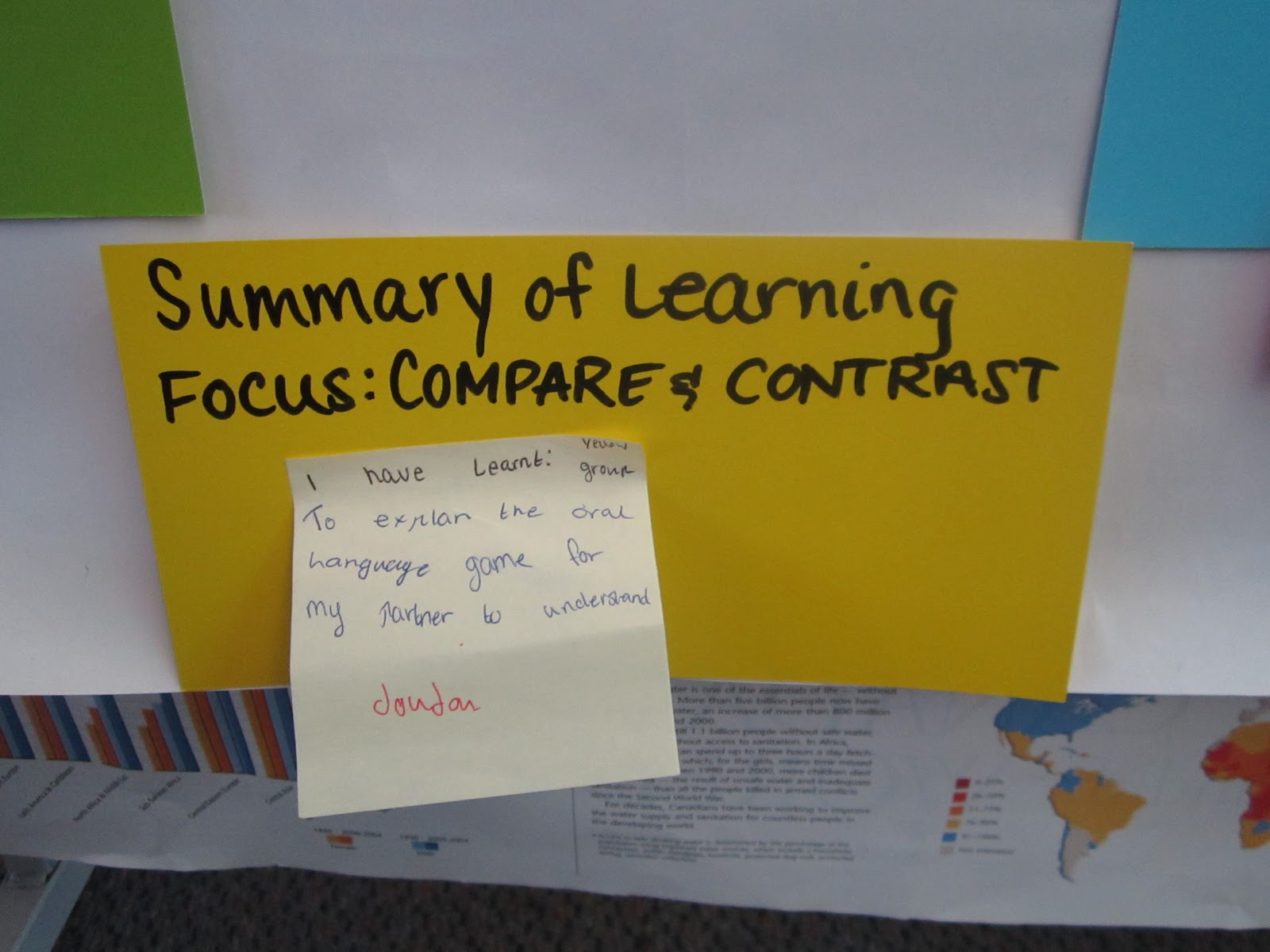
One of my favourite parts of the poster is the "Summary of Learning" section. At the end of each reading session, one student from each of my reading groups writes what they have learnt that day on a sticky note, presents it to the class and places it on our chart. These sticky notes can then be used for teacher formative assessments based on student self-evaluation. 


Monday, 29 October 2012

Summarising a Video Clip

I've posted before about One Dollar Sentences and how much I love that strategy for almost any subject area or topic.

Today we did a group activity on summarising and it was amazing to see the level of engagement from all the students. Students were placed in mixed ability groups and given the task to watch a brief video clip from Behind the News. While they watched the video clip, they were to jot down the key words from the clip. 


As soon as the clip ended, students were given five minutes in their groups to create a "one dollar sentence" to summarise the main idea of the video clip. Today, every word was worth five cents, thus a one dollar sentence needed to have exactly twenty words in it. Groups were awarded point for have twenty words exactly, having correct grammar and summarising the key facts. Students' competitive spirits were ignited and the race was on. 

We did this activity a few times with different video clips and it was great to see the improvement in the sentences and summarising. Some students began with summarising in two sentences and then were able to restructure their words to ensure it was only one sentence. Here are some examples:


Sunday, 21 October 2012

One Dollar Sentences

A short one but a good one!

I learnt about this while I was in teacher's college as a strategy to help students explain an idea/concept/etc. in a short sentence. I've used this strategy in high school and now I often use it in primary school and students find it exciting and a challenge. 

It is called a $1 sentence and each word is worth 10 cents. Students are asked to respond to a question or summarise a passage in a one dollar sentence (ten words only!). 

Try it out!!! Trust me it is wonderful!

Saturday, 20 October 2012

Possible Sentences

I learnt about this activity in a PD I went to on teaching EAL (English as an Additional Language) students. It is called possible sentences and can be used in reading and writing and also can be modified to be used across all year levels. 

It must be used on a familiar topic but it is a great way to introduce new vocabulary to the students. My example is on London and I have used information from Microsoft Encarta to create the example. 

Students are given a sheet (or place this on the IWB) that looks like the following:

LONDON


1.       capital city, United Kingdom
2.       largest city, Europe
3.       population, 8 million people
4.       the Queen, lives, Buckingham Palace
5.       Westminster Abbey, famous church
6.       transportation, the Tube, double-decker buses

     Only the key words are provided to the students. Their challenge is to put together a sentence using the exact words on each line. So they will essentially build a paragraph of six sentences based on this example and in sentence one, the must use the words "capital city" and "United Kingdom". 

     My students really enjoyed this activity and I've used it to teach new vocabulary, to focus on an area of grammar (such as past tense or writing consistently in a tense) and to model what a paragraph should look like for a writing style.

    If you find this activity is to easy for some students, you can challenge them by stating that their sentence must start with a particular word. For example, a sentence I would make for line one is: The capital city of the United Kingdom is London. But, if I challenge the students and state that they must start the sentence with the word "United Kingdom", it forces students to change their sentence structure and add in more words to something like this: United Kingdom is a collection of countries, yet, the capital city is located in London, England.

     This can also be used at the younger levels by helping students create a sentence by giving them the key vocabulary to use, rather than a paragraph. An EAL strategy but also so useful for language development in native English speakers!

Sunday, 14 October 2012

Sculpting

This is an EAL (English as an Additional Language) strategy that I learnt about at a PD by Margery Hertzberg. The name of this activity is "Sculpting" and is a great way to assess whether your students have understood a concept, storyline, definition or idea. Hence, there are a number of ways that you can use this activity. 

I used this in my reading class as a way of students showing their understanding of a new word we learnt that week. The focus in the class that week was making meaning of unfamiliar words.

Teammates sharing a high five after a win with an excited commentator and spectator on the side.

For this activity, students had two minutes in their groups to create (sculpt) a still frame image  to represent to word "commentator" as that was a new word we learnt. I was sooooo impressed with the creativity of the students and all the different ideas they came up with for their image.I've covered their faces for privacy, but the facial expressions added to their images also.

This was a great way for EAL students to show their understanding of a new word. Sometimes they are not always able to verbalise their understandings, thus this activity allows these students to show their understandings in a creative way still proves their learning. This can also be an oral language activity as students need to communicate with their group members to create their sculpture.

A running race with a spectator and commentator on the sidelines.

A basketball game with a commentator on the side of the court.

A ballet performance with a host commentator.


Tuesday, 2 October 2012

Boy Overboard

This is a book I just finished reading to my class and they absolutely loved. It is a Morris Gleitzman book so it included lots of humour. I was a little apprehensive to read this story as it is about a family of refugees from Afghanistan that are trying to immigrate to Australia. Many of the students in my class share similar stories to the main characters in the book, hence I wasn't sure if it would evoke any negative feelings with the students. 

Instead it had an opposite effect and students were able to have a greater understanding of the characters and their backgrounds. This is a great book for creating an inclusive curriculum in your classroom. It is also quite an enjoyable read for adults too!

Thursday, 20 September 2012

Hot Seat

I've been focusing on questioning in reading and an activity that I found really useful and students love is called "Hot Seat".  I learnt about this activity when I was on a professional development workshop titled Teaching EAL Students in Mainstream Classes  presented by Margery Hertzberg.

During the reading session students read a passage that includes some details on a character, whether fictional or real. After reading the passage, the student is put in the hot seat. They sit on the teacher's chair and take on the role of that character. Students in the class are then able to ask the character questions and the student in the "hot seat" needs to answer with the information they've gained from the passage.

Some questions may be evaluative or inferential, thus, students in the hot seat have to make an inference about how the character may act or feel in a specific situation. 

This activity works well for assessing students comprehension of the passage and also the ability of students to form literal, inferential and evaluative questions. For reading, I follow John Munro's High Reliability Literacy Teaching Procedures. One of the strategies is questioning and this activity falls right into this category.

I would love for other teachers to try this out and send me their feedback and any modifications that worked well. :)

Thursday, 13 September 2012

Reading Groups

It has taken me a while to organise my reading group in a way that runs smoothly and I think I have finally sorted it out. At the beginning of the year, many of my students were not independent learners, so if I was working with one group, many of the other students in the class struggled to complete their assigned tasks. I kept changing and modifying my lessons and tasks until I realised that it had to do with the structure of my lesson.
Our lessons run on a whole-part-whole basis that starts with a whole class focus, then has students break off into groups to complete two individual activities, and finally return to the carpet for share time. During our reading session, there is always a group working on an oral language task (especially since 94% of our students are EAL learners), another group on a computer task, next doing a follow-up task, and a guided reading session with the teacher.
Instrumental to my reading group is a task board. Each group knows exactly what task they are working on and during what part of the lesson.


Although I have always used a task board, I have found that creating book boxes for each group that includes all the materials they need for that lesson is also essential.


And the last thing that makes my reading group run smoothly are task cards. I create new task cards every week for each new activity I have planned. If a group is working on oral language, they will have the task card in their book box. So not only do I verbally explain the task to the students, they also have a card in their book box that explains the task.

Here is an example of what you would find in a book box: guided reading books/materials, task cards for the various activities, and any worksheets or handouts that go along with the activity